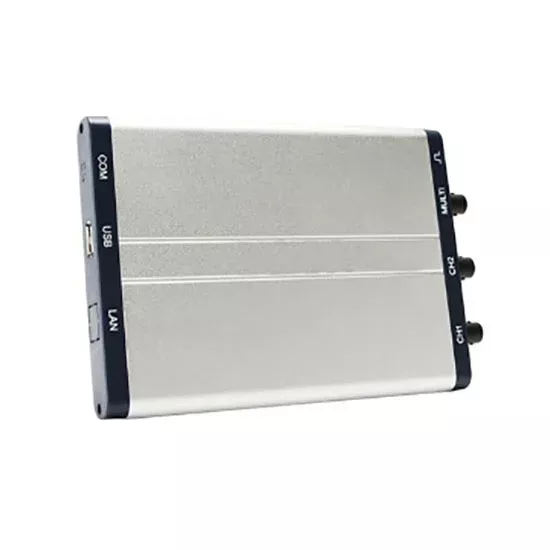
The dual-channel 60 MHz PC oscilloscope with 1 GSa/s sampling rate, 8 bits vertical resolution. PC oscilloscopes use high-performance modular hardware combined with efficient and flexible software to complete various test, measurement and automation applications.
Specification
| Model | ATO-VDC-2062 | ATO-VDC-2062L |
| Communication Interface | USB2.0 |
USB 2.0 (with LAN network port) |
| Bandwidth | 60 MHz | |
| Channel | 2 Channel+ Multi | |
| Sample Rate | 1 GSa/s | |
| Max. Input Voltage | 40V(DC + AC peak) | |
| Horizontal Scale (s/div) | 5ns/div – 100s/div, step by 1 – 2 – 5 | |
| Record Length | 5K | |
| Input Impedance | 1MΩ ± 2%, in parallel with 10pF ± 5pF | |
| Vertical Sensitivity | 5mV/div – 5V/div | |
| Vertical Resolution | 8 bits | |
| Trigger Type | Edge, Pulse, Video, Slope, and Alternate | |
| Automatic Measurement | Vpp, Vavg, Vrms, Frequency, Period, Vmax, Vmin, Vtop, Vbase, Vamp, Overshoot,Pre-shoot, Rise Time, Fall Time, +Width, -Width, +Duty, -Duty, DelayA→B , DelayA→B | |
| Waveform Math | +, -, *, /, FFT | |
| Power Supply | ≤6.5W | |
| Dimension (W * H * D) | 190* 18* 120mm | |
| Weight | 0.26 kg |
Accessories
- Power cord
- CD rom
- USB cable
- Probe
- Probe Adjust
- Multimeter lead
- Adapter
- User manual
- 5V, 1KHz Output
- Capacitance Ext Module
- Soft Bag
- Metal Case (optional)
Dimension (mm)
Tips: What is an oscilloscope?
The oscilloscope is a kind of electronic testing instrument which is widely used. It can convert electronic signals invisible to the human eye into visible images, which is beneficial for us to study the transformation process of various electrical phenomena. The oscilloscope uses a narrow electron beam composed of fast electrons to hit the screen coated with fluorescent components to form a small spot. Under the function of the signal under test, the electron beam is like the tip of a pen, which can draw the transition curve of the instantaneous value of the signal under test on the screen. The oscilloscope can be used to view the waveform curves of various signal amplitudes changing with time, and it can be used to detect various electric quantities, such as voltage, current, frequency, phase difference, amplitude modulation, etc.